
Cape HealthTech Connect 2026 puts collaboration at the heart of health innovation
Cape HealthTech Connect 2026 brought researchers, clinicians, entrepreneurs, investors, funders and industry leaders together on 17 September 2026 at the Biomedical Research Institute, Tygerberg, to explore a central challenge facing health innovation in Africa: how do promising ideas move from research and clinical need to solutions that create real-world impact? The programme comprised a keynote address, two panel discussions, startup and research pitching sessions, exhibitions and networking, creating opportunities for participants from across the health innovation ecosystem to connect around emerging technologies, funding, commercialisation and collaboration.
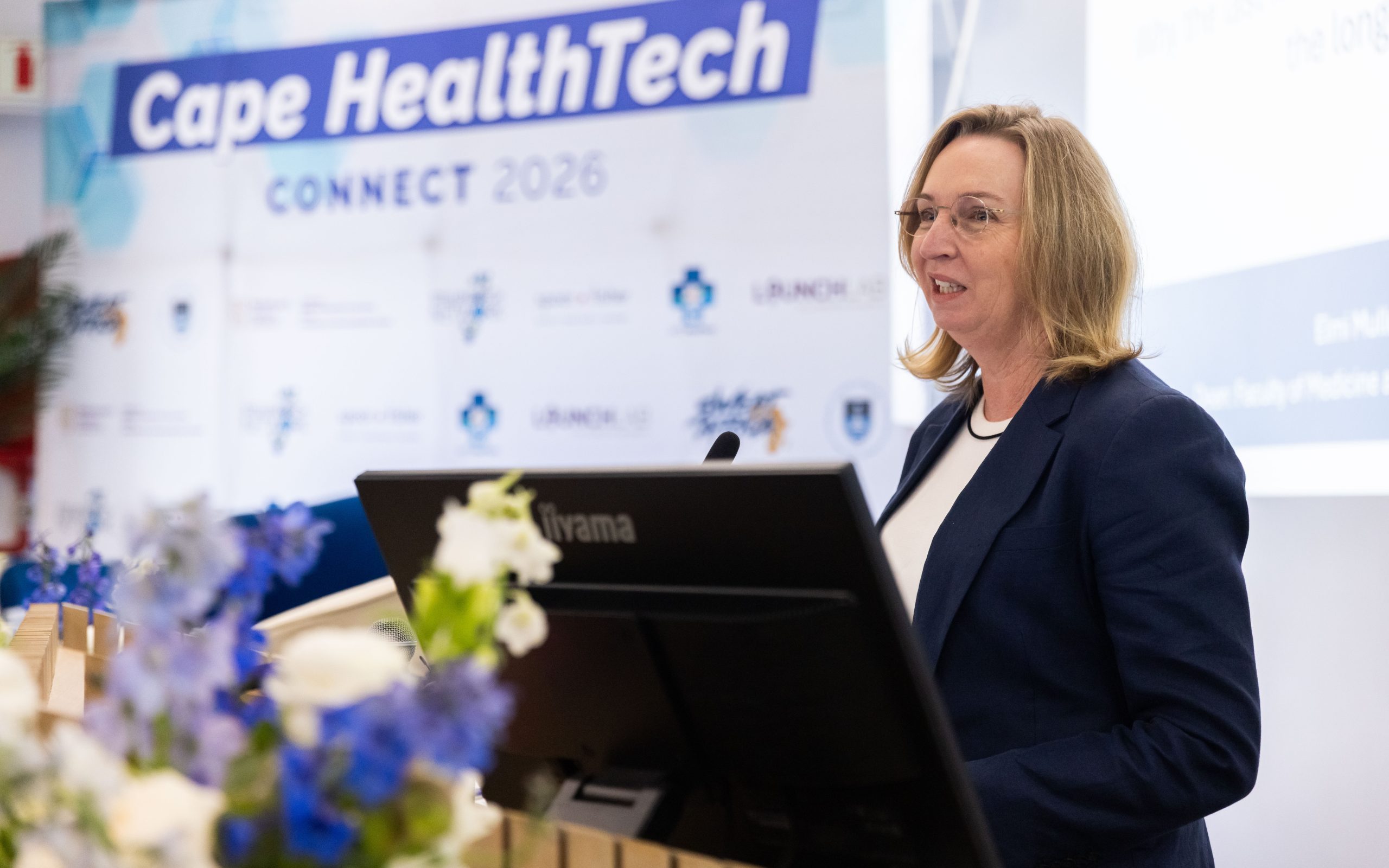
On her keynote address, Prof Elmi Muller, Dean of Stellenbosch University’s Faculty of Medicine and Health Sciences, set the tone for the day, reflecting on why some promising health innovations progress while others fail to reach the people who need them. Using the analogy of a river travelling towards the sea, she described how ideas can lose momentum when there are gaps in incentives, time, funding, technical support and connections. In resource-constrained healthcare environments, she noted, clinicians are often consumed by immediate service-delivery demands, leaving limited space to develop innovative ideas. She described this gap between a promising idea and its eventual application as a “missing middle” that needs to be deliberately addressed.
Muller illustrated the power of collaboration through work addressing tuberculous meningitis in children, where an urgent clinical problem drove collaboration between clinicians, scientists and technical experts towards a faster diagnostic approach. She also drew on her own experience in transplantation, where collaboration across clinical medicine, virology, ethics and other disciplines enabled pioneering work involving HIV-positive organ donors and recipients. Her message was clear: “African innovation does not have to mean a cheaper version of a northern product. No, it can mean setting the standard.”
That challenge flowed directly into the first panel discussion, ‘Funding the pipeline: Investors, grants and the innovation challenge’, moderated by Brandon Paschal of SU LaunchLab. Jonathan Wilson of Third Way Capital, Rowena Luk of Africa Health Ventures, Ravini Moodley of Innovus Technology Transfer Office and Richard Gordon of the South African Medical Research Council brought perspectives from across the funding and commercialisation landscape. The discussion highlighted the importance of matching technologies with the right type of funding at the right stage, while recognising that scientific significance and research funding alone do not necessarily demonstrate commercial demand.
Moodley highlighted the diversity of Stellenbosch University’s health innovation portfolio, which includes devices, diagnostics, reagents, cell lines and therapeutics. Many university technologies, however, are still at an early stage and require translational funding to develop prototypes, generate validation data and test market interest. The panel highlighted the importance of engaging potential users, partners and industry early, so that innovators can better understand market needs and build evidence of commercial traction alongside scientific development.
The second panel discussion, ‘AI and data in African healthcare: Built for our context’, moderated by Azra Mboweni of Wesgro, brought together Prof Sara (Saartjie) Grobbelaar of Stellenbosch University, Johan Coetzee of AI Diagnostics, Dr Kamlen Pillay of InUversal Group and Prof Regan Solomons of Stellenbosch University. The conversation moved beyond AI as a future concept and examined how it is already being used to reduce administrative burdens, support screening and diagnostics, assist frontline healthcare workers and extend expertise into resource-constrained settings.
A strong theme was the need to build technologies around African realities rather than simply importing solutions developed for other environments. The panellists discussed constraints including connectivity, power, infrastructure, regulatory pathways and access to specialist care, while also emphasising the opportunity these challenges create for locally designed solutions. Grobbelaar argued that innovation should be developed with the people and systems that will ultimately use it, rather than designing technology for them and attempting to adapt it later.
Beyond the formal discussions, the event gave researchers and entrepreneurs an opportunity to put innovation in front of the wider ecosystem. Startup and research pitching sessions showcased Health Biosciences, Lupak Healthcare, VIVA Site, Norni Labs, Southern Edge Bio, Young Engineers and PAGA, providing a platform for emerging health technologies and ventures to share their work with potential partners, funders and collaborators. Exhibitions running alongside the programme created additional space for innovators and organisations to demonstrate their technologies, continued conversations sparked during the sessions and made connections across universities, industry, investment and the startup community.
In remarks on behalf of Innovus and Stellenbosch University, Nolene Singh, Deputy Director of Innovus TTO, noted that researchers, industry, entrepreneurs, investors and funders each contribute different capabilities to the innovation journey. “Technology Transfer Offices increasingly sit at the intersection of these communities, helping researchers identify promising innovations, protect intellectual property where appropriate and build pathways that can take technologies beyond the university,” she said.
Singh emphasised that the value of Cape HealthTech Connect extended beyond the formal programme. A researcher could meet an industry partner who understands how technology might be applied; a startup could meet someone able to help navigate a regulatory or commercial challenge; an investor could discover technology earlier than they otherwise would; and industry could identify expertise within universities capable of addressing real-world problems.
Chyreene Truluck, Partner at Spoor & Fisher, similarly reflected on the role of intellectual property as more than a legal mechanism. She said, “IP can become an asset that enables researchers and startups to begin conversations with investors and commercial partners, while supporting the journey from research to commercialisation and impact”. Her remarks reinforced the importance of relationships across the ecosystem and the role events such as Cape HealthTech Connect play in creating those relationships.
Cape HealthTech Connect 2026 was a collaboration between Stellenbosch Network, SU LaunchLab, Centre for Epidemic Response and Innovation and Sweat Africa and sponsored by Innovus TTO, University of Cape Town and Spoor & Fisher. The event demonstrated that translating African health innovation into impact is not a linear journey. Scientific excellence remains essential, but so do funding, intellectual property, entrepreneurship, regulatory pathways, market understanding, appropriate infrastructure and sustained collaboration.
Related Posts
LaunchLab builds global partnerships to accelerate innovation and entrepreneurship
From Madison to Dallas, Stellenbosch University's (SU) LaunchLab strengthened international partnerships that could unlock new opportunities for entrepreneurs, researchers, and spinout companies. As innovation becomes increasingly global, strong international partnerships are essential for translating research into real-world impact. During a…
SU LaunchLab expands its team to strengthen innovation and entrepreneurship
SU LaunchLab is pleased to welcome three new team members, further strengthening its ability to support entrepreneurs, innovators, and the broader Stellenbosch ecosystem. Elijah Djan joined as an Incubation Programme Officer, where he will lead incubation programmes designed to support…
Building the next generation of student entrepreneurs at Stellenbosch University
Entrepreneurship has long been part of the Stellenbosch University (SU) story. From pioneering research and breakthrough technologies to student-led ventures tackling real-world challenges, the University has cultivated an environment where ideas can become meaningful impact. Recognising the need to create…